


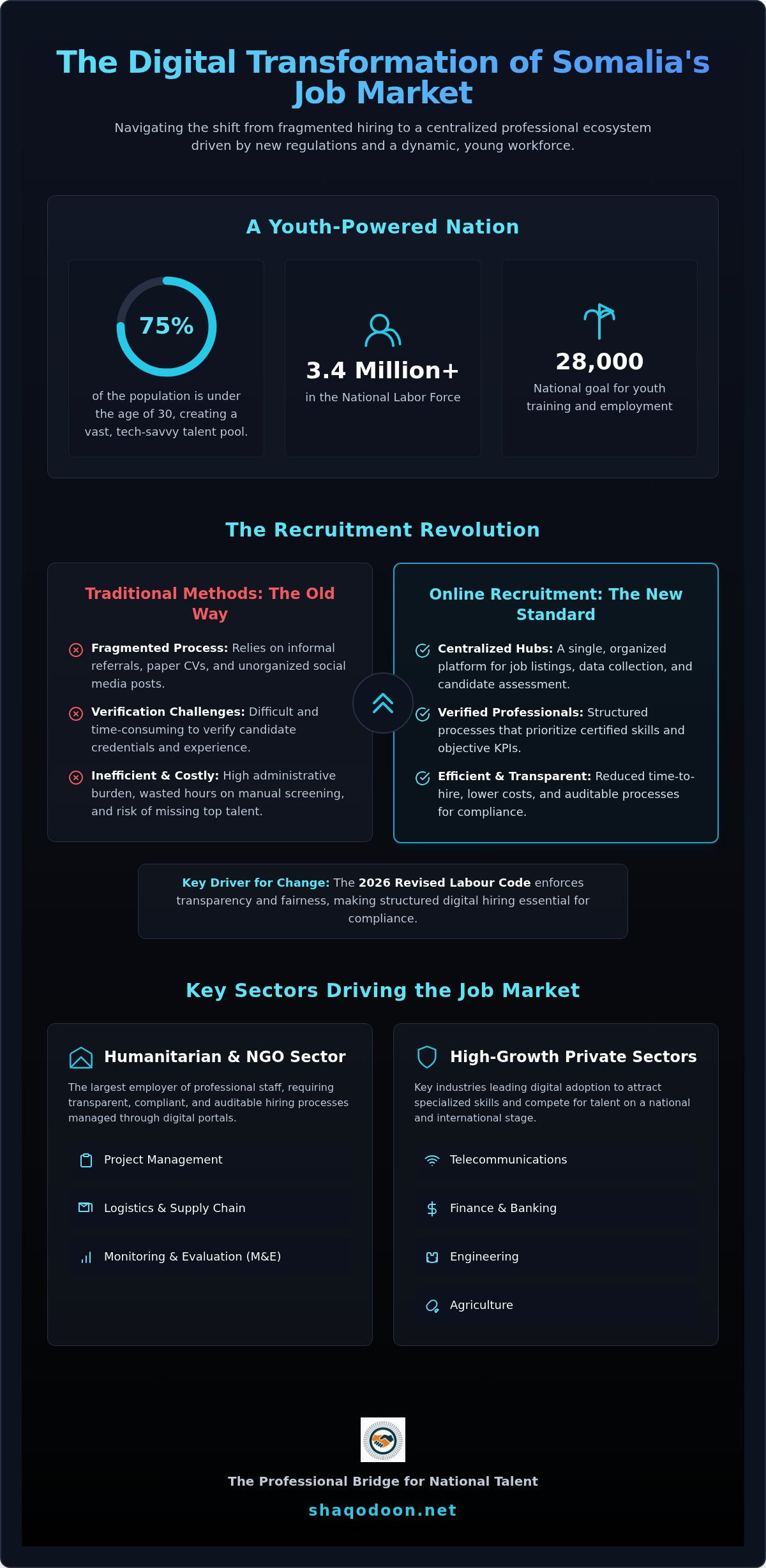
With 75% of the population under age 30, online recruitment Somalia has transitioned from a modern convenience to a critical business infrastructure. Traditional hiring methods often result in a fragmented process that leaves employers overwhelmed by unqualified applications. Verifying candidate credentials remains a primary pain point, especially as the Federal Government of Somalia enforces the 2026 Revised Labour Code to ensure transparency. Adopting a structured approach to online recruitment Somalia is now essential for maintaining professional standards and operational efficiency.
You need a streamlined system that connects you with verified professionals without the administrative burden of manual sorting. This guide provides a comprehensive framework to master online recruitment Somalia, whether you’re looking to hire top talent or advance your own career. You’ll learn how to navigate the new regulations for private employment agencies and utilize centralized platforms to reduce your time-to-hire. We’ll examine current labor force statistics, the impact of government initiatives, and the best practices for managing job listings in this evolving landscape.
Key Takeaways
- Understand how transitioning to a centralized digital infrastructure replaces fragmented, informal hiring methods.
- Identify high-growth opportunities in the NGO and private sectors through online recruitment Somalia.
- Learn to implement structured screening processes that prioritize verified professional certifications and technical KPIs.
- Ensure organizational compliance with the 2026 Revised Labour Code and new private employment agency regulations.
- Leverage Shaqodoon as a methodical connector to streamline talent sourcing across the national labor market.
The Shift to Digital: Online Recruitment in Somalia
The employment landscape is undergoing a fundamental transformation. Employers are moving away from informal referrals toward centralized digital systems. This transition defines online recruitment Somalia in 2026. Digital portals now replace the traditional reliance on paper applications and unorganized social media announcements. The shift’s primarily driven by a requirement for operational efficiency. As Somalia’s developing economy matures, the demand for structured hiring increases. Sectors like telecommunications, agriculture, and finance now lead this digital adoption.
Technology acts as the primary bridge between national talent and professional opportunity. High internet penetration rates among the youth population have standardized recruitment expectations. Job seekers now expect professional interfaces and clear application tracking. This digital environment forces a higher standard of transparency. It aligns with the 2026 Revised Labour Code, which emphasizes fairness and accountability. Organizations that ignore digital sourcing risk losing access to the most tech-savvy and qualified segments of the labor force. Compliance with new standards is easier when you maintain digital records of all hiring activities.
The Need for Centralized Professional Hubs
Fragmented recruitment methods create significant obstacles for expanding organizations. Relying on multiple uncoordinated sources leads to duplicated efforts and missed talent. Centralized hubs provide a standardized environment for all parties. They allow for uniform data collection and objective candidate assessment. This structure simplifies the verification of professional credentials, which remains a challenge in informal markets. A mobile-first workforce requires real-time access to vacancies. Digital platforms provide this immediacy. They ensure that job information is current and accessible to the national labor force of over 3.4 million people. Shaqodoon functions as the methodical expert in this space. The platform organizes complex recruitment data into actionable listings, acting as a stable infrastructure for the national market.
The Economic Impact of Digital Hiring
Digital systems optimize the allocation of human capital across the country. For small and medium enterprises, reducing the cost per hire is essential for long-term sustainability. Online sourcing minimizes the administrative hours spent on manual screening and physical document storage. This efficiency accelerates the placement of skilled workers in high-growth industries like engineering and humanitarian aid. National workforce mobility depends on accessible, centralized data. When job listings are consolidated, professionals can identify opportunities across different sectors without geographic barriers. This connectivity supports the national objective of providing training and employment to 28,000 young people. It builds a stable infrastructure for future economic growth and professional mobility.
Key Sectors Driving the National Job Market
The Somalian professional job market is a multi-sector ecosystem where private enterprise, government initiatives, and international development coexist. This diverse landscape requires a sophisticated approach to online recruitment Somalia to ensure all vacancies reach the right talent pools. Employers are no longer limited to local networks; they now compete on a national and international stage for specialized skills. The demand for qualified professionals is particularly high in sectors that require technical expertise and regulatory compliance.
The Humanitarian and NGO Landscape
International organizations and non-governmental organizations (NGOs) remain the largest employers of professional staff. These entities rely on digital portals to ensure their hiring processes meet global compliance and transparency standards. Because these organizations often manage significant donor funding, they must provide a clear, auditable trail for every recruitment cycle. Standardized online application processes help eliminate the risks associated with informal networking and nepotism. Common professional roles in this sector include:
- Project Management: Oversight of development initiatives and community programs.
- Logistics and Supply Chain: Managing the movement of essential goods and services across the country.
- Monitoring and Evaluation (M&E): Ensuring program goals are met through data-driven analysis.
By utilizing centralized platforms, these organizations reach a verified talent pool that understands the specific requirements of the humanitarian sector. You can post your job listings on a professional portal to maintain these high standards of transparency.
Emerging Private Sector Opportunities
National companies are rapidly adopting formal human resource practices to support their growth. The growth of the ICT sector has provided the digital foundation for this modernization. Banking, telecommunications, and construction firms are leading the shift toward digital sourcing. There is a growing demand for skilled professionals in finance and engineering to support infrastructure development and financial stability. Online recruitment visibility is also a primary tool for attracting diaspora talent. These individuals often bring international expertise but require a reliable digital bridge to find professional opportunities within the country. Understanding the full scope of private sector jobs Somalia offers in 2026 is essential for professionals seeking sustainable career growth beyond the humanitarian space. As formal HR departments become the standard, the reliance on Somalia job sites for employers will continue to expand, ensuring a more efficient match between skills and vacancies.
Benefits of Online Recruitment for National Employers
Digital adoption provides immediate advantages for national organizations. Online recruitment Somalia enables a shift from passive talent gathering to active, precision-based sourcing. Employers no longer need to rely on physical bulletin boards or local radio announcements. A single digital listing provides visibility to the entire national labor force of over 3.4 million people. This efficiency is critical for organizations managing tight budgets and high-priority timelines. It ensures that resources are spent on evaluating talent rather than gathering it.
Quality control improves through the use of digital filters. These tools allow recruiters to identify specific qualifications, years of experience, or language proficiencies instantly. This reduces the burden of manual review. Speed is another primary benefit. Organized dashboards allow HR teams to move from posting to shortlisting in a fraction of the time required by traditional methods. Compared to the logistical costs of physical application centers, digital listings are highly cost-effective. They eliminate the need for paper storage and dedicated administrative staff for manual data entry.
Streamlining the Talent Sourcing Workflow
Digital platforms transform how HR departments manage their daily operations. Moving from manual CV sorting to automated candidate management reduces human error. It prevents qualified professionals from being overlooked during high-volume application cycles. A centralized repository for applications provides a single source of truth for the entire organization. This structure allows different departments to collaborate on hiring decisions without duplicating efforts. Professional job listings also improve employer branding. A well-organized digital presence signals to candidates that the organization is stable, modern, and professional.
Accessing a National Talent Pool
Geographic barriers often limit the reach of traditional recruitment. Online systems overcome these limitations. They allow employers to find specialized skills regardless of where the candidate is located. This is essential for hiring for field-based roles in remote areas. Accessing a national pool ensures that the best talent is found, not just the nearest talent. Organizations can also build a database of potential hires for future vacancies. Instead of starting the process from zero for every new role, recruiters can search their existing digital archives. This proactive approach supports long-term workforce planning and reduces future time-to-hire metrics. It creates a sustainable pipeline of verified professionals ready for deployment.
Optimizing Your Recruitment Strategy in Somalia
Strategic hiring requires more than just posting a vacancy. It demands a methodical approach to attract and retain the best talent. Successful online recruitment Somalia depends on a structured four-step process. First, you must craft precise and professional job descriptions. Second, select a platform with national reach to ensure maximum visibility. Third, implement a rigorous screening and interview process. Finally, manage all candidate communication through a centralized portal. This structure ensures that your hiring team remains organized and that candidates receive a professional experience. It’s a system designed to eliminate guesswork and focus on data-driven results.
Writing Effective Job Postings
A professional job listing is your first point of contact with potential hires. It must be clear and descriptive to attract the right demographic. Start with a standard job title that reflects the actual seniority and function of the role. Avoid vague descriptors that don’t clarify the job’s purpose. Every listing should include specific responsibilities and required qualifications. Use industry-standard terminology to signal your organization’s professional standards. You should also set clear deadlines and provide explicit application instructions. This reduces confusion and prevents your team from receiving incomplete submissions. For a detailed walkthrough of every step involved, review the comprehensive employer guide to posting a job in Somalia to ensure your listings meet 2026 compliance standards. You can post a job today to start reaching a national audience of verified professionals.
Screening and Selecting Top Candidates
Efficient screening is the most critical part of the recruitment workflow. You must identify key performance indicators (KPIs) within each resume to gauge a candidate’s potential impact. Look for concrete data points, such as project completion rates or specific budgetary management experience. Professional certifications are also vital in the national market. In sectors like finance and engineering, credentials like ACCA or PMP provide objective proof of expertise. When you transition to the interview stage, maintain a formal environment. Best practices for interviews include:
- Standardized Scoring: Use a consistent rubric to evaluate all candidates for the same role.
- Technical Assessments: Include practical tests to verify specific skills mentioned in the application.
- Behavioral Questions: Ask for specific examples of how the candidate handled professional challenges.
Managing the flow of information is easier when you use portal-based tools. Direct communication through the recruitment platform keeps all records in one place. It allows you to update candidates on their status quickly, which protects your employer brand. A structured strategy reduces the risk of a bad hire and ensures your organization remains compliant with national labor standards. This methodical approach turns recruitment from a logistical burden into a competitive advantage for your business.
Shaqodoon: The Professional Bridge for National Talent
Shaqodoon functions as the authoritative facilitator for the national job market. It transforms fragmented data into organized, actionable listings. This platform maintains a commitment to professional standards. It prioritizes functional efficiency. By providing a stable infrastructure, it bridges the gap between diverse sectors and a national talent pool. Organizations use these digital tools to build high-performing teams. They avoid the administrative friction of traditional methods. It’s a system built for clarity and utility. The platform doesn’t just list jobs. It organizes the marketplace into a logical directory. This methodical approach ensures that both private and humanitarian sectors can find specific skills. It acts as a steady bridge between employers and qualified seekers. It provides a comprehensive view of the national labor force.
Navigating the Shaqodoon Platform
Employers benefit from dedicated tools. These tools streamline the hiring workflow. The “Post a Job” functionality allows for rapid deployment of vacancies. It reaches a national audience instantly. Once a listing is active, the platform tracks applications. You can manage candidate data in one location. This centralized dashboard eliminates the need for external spreadsheets. It removes the clutter of email inboxes. Job seekers find value in the organized directory structure. They search for opportunities by specific sectors. This categorization ensures that the right professionals find the right roles. It creates a focused environment. Productivity is the priority. The efficiency of these tools supports national growth. It reduces time-to-hire for critical professional roles.
The Future of Recruitment with Shaqodoon
The digital marketplace infrastructure requires continuous improvement. It must meet evolving economic demands. Shaqodoon remains dedicated to this evolution. It supports the next generation of Somalian professionals. It provides a transparent entry point into the formal economy. This focus on long-term growth aligns with national initiatives. It supports youth employment and skills development. As the primary hub for online recruitment Somalia, the platform ensures high professional standards. It provides the essential bridge for national progress. Reliability and objective authority define every interaction. You can rely on this stable infrastructure. It brings order to a vast and diverse marketplace. To begin your search or expand your team, Post your next job vacancy on Shaqodoon. This action connects your organization with a verified national talent pool immediately.
Building a Modern Professional Infrastructure
The transition toward structured digital systems is no longer optional for organizations seeking growth. Adopting online recruitment Somalia standards ensures your hiring process remains compliant with the 2026 Revised Labour Code while accessing a verified national talent pool. You now have the framework to craft precise listings and utilize centralized dashboards to reduce administrative friction. This methodical approach improves the quality of your hires and establishes a transparent environment for all parties.
Shaqodoon provides the methodical and efficient recruitment infrastructure needed to navigate this landscape. As a centralized hub for NGO and private sector roles, the platform offers national coverage across all professional sectors. It organizes complex market data into a logical directory, allowing you to focus on your core objectives while we facilitate the connection to skilled talent. By integrating these digital tools, you’re not just filling a vacancy; you’re building a more professionalized future for the national economy.
Start hiring top talent on Shaqodoon today and streamline your path to organizational success. Your next high-performing professional is ready to connect.
Frequently Asked Questions
How does online recruitment work in the Somalian market?
Online recruitment Somalia works through centralized digital marketplaces that connect employers with a national talent pool. Organizations register on professional portals to publish vacancies, while job seekers create profiles to apply for specific roles. This system provides a transparent alternative to informal referrals. It ensures compliance with the 2026 Revised Labour Code by maintaining an auditable trail of all hiring activities across the country.
Is it free for job seekers to use online recruitment portals in Somalia?
Yes, it’s free for individuals to search and apply for positions on national portals. The 2026 regulations for private employment agencies explicitly prohibit charging recruitment fees to workers. Platforms like Shaqodoon prioritize accessibility to ensure that all qualified professionals can connect with opportunities. Employers typically cover the costs associated with listing vacancies to reach a broader audience. This structure promotes fairness within the national labor market.
What are the most in-demand professional skills in Somalia for 2026?
Engineering, finance, and project management are the most critical professional categories for 2026. Employers prioritize candidates with recognized certifications, such as ACCA for financial roles or PMP for development projects. Technical skills in information technology are also in high demand as the private sector modernizes. These specialized skills are essential for supporting the projected 2.8% economic growth and the expansion of national infrastructure projects across multiple sectors.
How can an employer post a job vacancy on a national platform?
Employers use the “Post a Job” functionality on centralized portals to reach a national audience. You must first register a professional account and provide your organization’s details. Once verified, you can upload precise job descriptions, set application deadlines, and define required qualifications. For a step-by-step walkthrough of this process, the employer guide to posting a job in Somalia covers every requirement under the 2026 Labour Code. This digital approach allows you to manage all submissions through a single dashboard, which significantly reduces the administrative burden of traditional hiring methods.
Can international organizations use Somalian job sites for recruitment?
International organizations and NGOs frequently use national job sites to find local talent. These entities require high levels of transparency and compliance to meet donor standards. Online portals provide the structured environment necessary for these rigorous recruitment processes. By listing vacancies on a centralized marketplace, international employers can access a verified pool of professionals who understand the local context and possess the required technical expertise.
What is the typical timeline for hiring a professional candidate online?
The timeline varies depending on the role’s complexity, but digital platforms significantly accelerate the process. Using organized dashboards allows HR teams to move from posting to shortlisting in a few weeks. This is much faster than manual CV sorting. Centralized systems provide real-time updates and automated filtering, which helps identify top candidates quickly. Efficient communication through the portal ensures that the total time-to-hire remains competitive for critical professional positions.
Are there specific sectors that dominate online job listings in Somalia?
The humanitarian sector, telecommunications, and banking currently dominate the digital job market. These industries require specialized professional skills and high levels of transparency in their hiring practices. Online recruitment Somalia is also growing in the construction and agricultural sectors as national companies adopt formal HR standards. Centralized portals help these diverse sectors organize their recruitment data into actionable listings that attract the most qualified candidates from the national workforce.
How can job seekers optimize their online applications for national roles?
You should focus on using industry-standard terminology and highlighting specific professional certifications. Ensure your digital profile is complete and includes concrete data points about your previous project successes. Tailoring your application to the specific requirements of the sector increases your visibility to recruiters. Many employers use Somalia job sites for employers that include digital filters to screen for specific qualifications, so accuracy and professional detail are essential for successfully securing a national role.