


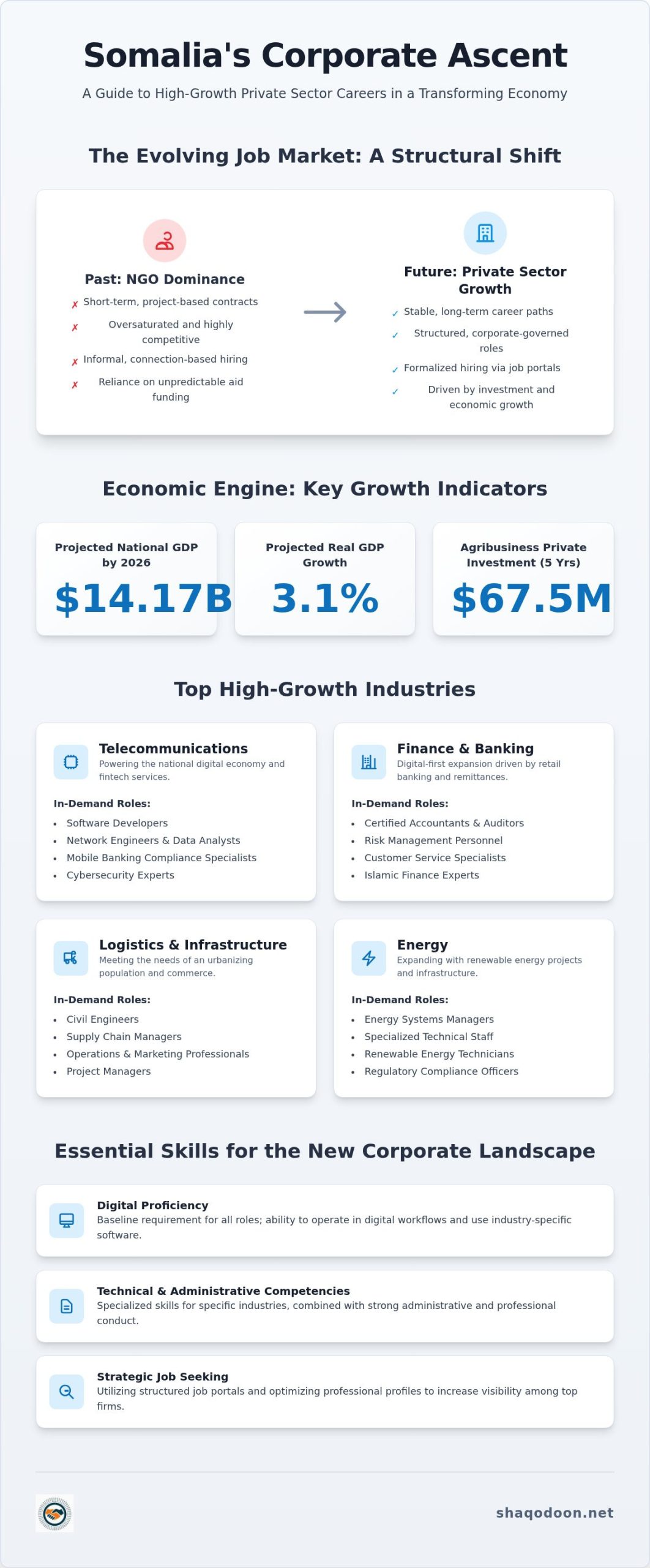
The era of the NGO as the primary engine for professional advancement in Somalia has ended. You’ve likely felt the pressure of high competition and oversaturation within the humanitarian sector. As the economy transitions toward a service-based model, the most sustainable career paths are shifting. Finding the high-growth private sector jobs Somalia offers is now the priority for a new generation of corporate leaders. With the national GDP projected to reach $14.17 billion in 2026, the commercial landscape is expanding faster than traditional aid-funded roles.
You need reliable data to navigate this changing market effectively. This guide identifies the specific industries, such as telecommunications and banking, that are currently scaling their operations. We’ll outline the exact recruitment standards top Somali firms expect and how you can meet them. You’ll also learn to use digital portals to streamline your search and bypass the uncertainty of informal hiring. This article provides a clear strategy to help you identify high-growth industries and secure a position in Somalia’s most stable and profitable commercial sectors.
Key Takeaways
- Analyze the structural transition from humanitarian-led employment to a corporate-governed commercial landscape driven by digital transformation and increased investment.
- Identify high-growth private sector jobs Somalia offers within the telecommunications and banking industries, where mobile money and Islamic finance are scaling rapidly in 2026.
- Evaluate the long-term career advantages of corporate roles compared to the NGO sector, specifically regarding professional longevity and versatile skill development.
- Determine the precise technical and administrative competencies, such as digital proficiency and corporate governance, required by top national employers.
- Learn how to utilize structured job portals and profile optimization techniques to increase visibility among leading private firms and secure stable commercial positions.
The Evolution of the Somali Private Sector Job Market
The Somali job market has transitioned away from the historical dominance of humanitarian aid agencies. In 2026, the Economy of Somalia is increasingly defined by its private sector, which now serves as the primary engine for GDP growth. This shift represents a move from localized, informal trade toward structured, corporate-governed industries. Unlike the previous decade, where short-term NGO contracts were the professional gold standard, current experts are seeking the stability found in private sector jobs Somalia now provides. This evolution is supported by a projected real GDP growth of 3.1%, signaling a maturing market that rewards technical expertise and administrative professionalism over generalist aid experience.
From Informal Trade to Corporate Structure
The landscape has moved toward formalized business registration and clear professional hierarchies. Somali firms are establishing dedicated Human Resources departments to manage complex staffing needs. These departments prioritize long-term talent retention, moving away from the “project-based” hiring cycles common in the humanitarian sector. National job portals have become essential tools in this transition. They provide a structured marketplace that standardizes the hiring process. By using these portals, employers can verify qualifications and follow objective corporate standards. This structure allows companies to build stable internal cultures and predictable career paths for their employees. It’s a significant departure from the informal, connection-based hiring models of the past.
Investment Trends Fueling Employment
Increased foreign investment and national stability have catalyzed growth in heavy industries and services. Infrastructure projects and renewable energy plants now require specialized technical staff, including civil engineers and energy systems managers. The agricultural sector alone has seen an estimated $67.5 million in private investment over the last five years, creating a surge in demand for modern agribusiness professionals. Additionally, the burgeoning startup ecosystem is creating a new tier of entry-level professional roles in marketing and operations. Digital literacy is no longer a niche skill; it’s a baseline requirement for almost every commercial role in 2026. Companies are looking for candidates who can operate within digital workflows and use industry-specific software to drive efficiency. This transformation ensures that private sector jobs Somalia remains resilient against external economic shocks while providing a diverse range of professional opportunities for the national workforce.
High-Growth Industries Driving Private Sector Employment
In 2026, the demand for private sector jobs Somalia is concentrated in four primary pillars: telecommunications, finance, logistics, and energy. These sectors are expanding rapidly to meet the needs of an increasingly urbanized population and a growing consumer market. As traditional aid-funded roles become more competitive, these commercial industries provide a more sustainable path for professional career growth. The shift toward a service-based economy is creating specialized roles that require technical expertise and structured management skills.
Telecommunications and the Digital Frontier
The tech sector serves as the backbone of the national digital economy. Software developers, network engineers, and data analysts are in high demand as firms scale their digital infrastructure to support high internet penetration rates. The expansion of fintech services has created a specific need for roles in mobile banking compliance and security. Because of the technical expertise required, telecommunications firms often offer the most competitive compensation packages in the 2026 job market. Professionals in this field are expected to manage complex digital workflows and ensure the reliability of essential communication networks.
The Finance and Banking Sector Expansion
Banking is undergoing a digital-first transformation that prioritizes efficiency and accessibility. Growth in retail banking has necessitated a surge in customer service and risk management personnel to handle a larger volume of individual accounts. National commercial banks are actively recruiting certified accountants and auditors to maintain high professional standards and regulatory compliance. This sector is heavily influenced by the $1.3 billion in annual diaspora remittances, which requires robust financial infrastructure to manage effectively. Professionals with experience in Islamic finance and mobile money integration are particularly valued as the industry matures. You can browse current vacancies in these expanding fields by using the Shaqodoon job portal to filter for specific corporate roles.
Logistics and renewable energy are also emerging as major employers in the 2026 landscape. Managing the flow of over $1.5 billion in annual processed food imports requires sophisticated supply chain management and logistics coordination. Meanwhile, the rise of solar and hybrid solar-wind plants has created a new category of engineering opportunities. Technical staff capable of designing and maintaining large-scale renewable grids are finding stable, long-term employment. These industries are moving away from temporary labor toward a permanent, skilled workforce that can support national infrastructure goals.
Private Sector vs. NGO Roles: A Strategic Comparison
Historically, professionals prioritized the humanitarian sector for its high entry-level salaries and perceived prestige. However, the 2026 landscape shows that private sector jobs Somalia offers provide superior career longevity. NGO roles are typically tied to donor funding cycles and specific project durations. This can lead to job insecurity when a mandate ends or a grant expires. In contrast, corporate roles are built on revenue generation and institutional growth. This creates a stable, long-term career ladder where advancement is based on performance rather than the availability of a new project. It’s a fundamental shift from temporary employment to institutional career building.
Compensation structures are also evolving to match international standards. While NGOs rely on fixed salary scales and “allowances,” private firms are increasingly using performance-based bonuses and equity options to attract top talent. This shift encourages a results-oriented work culture. Instead of focusing on compliance and donor reporting, corporate employees are incentivized to drive efficiency and market expansion. The skill development models reflect this difference. NGO training is mission-specific, whereas corporate experience builds versatile competencies in financial management and market analysis. These skills are transferable across various commercial industries, making you a more resilient professional in a maturing economy.
Evaluating Your Career Path
Choosing between these sectors requires a clear framework. If your goal is to build a professional network within national industries, the commercial sector is the logical choice. Translating NGO experience for a corporate resume is essential for this transition. For example, you should focus on your ability to manage budgets, lead teams, and meet strict deadlines. Private firms value these practical outcomes over humanitarian jargon. Building relationships with local business leaders provides a level of career security that donor-funded roles cannot match. It’s about investing in your future within the national infrastructure.
Recruitment Standards for Top Employers
Somali firms are adopting sophisticated recruitment standards to identify high-performing talent. There’s a clear shift toward competency-based interviewing, where candidates must demonstrate specific problem-solving abilities. Top employers now prioritize professional certifications, such as ACCA for finance or PMP for operations, over generalist experience. This standardization ensures that the workforce meets international business requirements. To understand how these firms source talent, consult the Somalia Recruitment Guide: Top Job Sites for Employers. This resource outlines the platforms and criteria that leading commercial entities use to vet their staff. Moving beyond “allowances” to performance-based bonuses also reflects a maturing work culture that rewards efficiency and results.
Essential Skills for Success in the Emerging Corporate Landscape
Securing the most competitive private sector jobs Somalia offers in 2026 requires more than a standard academic degree. As the national economy matures, employers are prioritizing candidates who demonstrate a blend of technical mastery and corporate professionalism. This shift is driven by the need for efficiency in high-growth industries like telecommunications and finance. Candidates must move beyond generalist experience to prove they can contribute to a results-oriented business environment immediately. Professional standards are higher than ever, and the competition for top-tier roles is intense.
Digital proficiency isn’t just a bonus; it’s a non-negotiable baseline. Mastery of office productivity suites and industry-specific software, such as ERP systems or CRM tools, is essential for daily operations. Professional English has become the primary language for regional trade and corporate communication. While national languages remain vital for local engagement, English is the standard for technical documentation and international reporting. Understanding corporate governance, including ethics and compliance, is also critical as firms seek to align with international professional standards and attract further investment.
Technical Competencies in High Demand
Formal project management methodologies are increasingly applied across various business operations. Mastery of Agile or PMP frameworks allows professionals to lead teams through complex tasks with precision. Financial literacy is also becoming a requirement for non-finance roles. Managers in marketing or logistics must understand data-driven decision-making and budget management to drive profitability. Specialized IT certifications, particularly in cybersecurity and data analysis, are currently the most direct route to securing high-tier positions in the 2026 market. They’re valuable assets that distinguish you from the general applicant pool.
Professionalism and Work Ethic
Adapting to the fast-paced, methodical rhythm of a corporate environment is essential for long-term success. National firms prioritize accountability and consistent, results-oriented performance. You must demonstrate professional reliability, especially during the initial probationary period, by meeting deadlines and following established organizational structures. This methodical approach ensures that the business maintains its momentum and hits its growth targets. To find roles that value these high-level competencies, you can access current job listings on Shaqodoon to match your skills with top national employers.
Navigating Private Sector Vacancies via Shaqodoon
Shaqodoon serves as the primary infrastructure for professional recruitment in 2026. It acts as the essential bridge between skilled candidates and expanding commercial industries. By centralizing private sector jobs Somalia offers, the portal brings order to a vast and diverse marketplace. You can bypass informal hiring networks and access verified corporate opportunities through a single, structured interface. The platform’s efficiency reflects a brand that values your time and prioritizes the delivery of essential data. It’s a high-performing tool designed to move you toward specific career outcomes with precision.
Maximizing Your Application Success
Utilizing the ‘Job Search for Job Seekers’ tool allows you to filter vacancies by specific commercial categories. This ensures you focus your efforts on roles that align with your professional trajectory rather than general listings. Optimizing your professional profile is equally critical for visibility to top national employers. These firms use the portal’s search functions to identify candidates with specific certifications and technical competencies. Ensure your profile includes industry-relevant keywords and lists your verified technical skills clearly. For a deeper understanding of how companies use the platform to find talent, review The Comprehensive Employer Guide to Posting a Job in Somalia (2026). This insight helps you align your profile with the exact criteria employers prioritize when vetting candidates.
Connecting with Top National Employers
Researching a company before submitting an application is a standard requirement in the corporate sector. Shaqodoon provides a centralized directory where you can track your application progress and manage communications with multiple firms simultaneously. Setting up automated alerts for specific private sector categories ensures you’re notified immediately when new roles become available. This proactive approach is essential in a fast-paced market where high-tier positions are filled quickly. The platform acts as a dependable guide, moving you from broad industry overviews to specific job details without unnecessary filler or decorative prose. Start your professional journey today by browsing private sector jobs in Somalia and positioning yourself as a leader in the national economy.
Using a structured job portal provides a level of security and professional standards that informal methods lack. In 2026, the ability to navigate digital recruitment tools effectively is a skill in itself. It demonstrates your proficiency with modern business infrastructure and your commitment to professional standards. By leveraging these tools, you can transition from temporary project work to a stable, long-term corporate career. The focus remains on guiding you through a logical progression toward your next professional milestone.
Securing Your Future in the 2026 Corporate Economy
Somalia’s economic landscape has undergone a fundamental transformation. The transition toward a service-based economy means that long-term career stability is now found within commercial industries rather than temporary aid projects. Success in this maturing market requires a commitment to international professional standards and technical mastery. High-growth sectors like telecommunications, banking, and renewable energy are actively seeking a new class of professional leaders to drive institutional growth. Navigating the private sector jobs Somalia offers requires a methodical approach to your professional search and profile management.
Shaqodoon remains the trusted bridge for national recruitment. It provides a centralized national job portal and a methodical marketplace for all professional sectors. The platform is the primary tool used by top national employers to identify and vet elite talent. You can find your next professional opportunity on Shaqodoon to align your skills with the nation’s most stable commercial entities. Your expertise is the essential foundation for the country’s continued commercial expansion. Take the next step in your professional development with confidence and precision.
Frequently Asked Questions
What are the highest paying private sector industries in Somalia for 2026?
Telecommunications and banking currently offer the most competitive compensation packages due to high technical requirements and revenue growth. In the 2026 market, specialized roles in renewable energy engineering and digital finance compliance also command premium salaries. These sectors prioritize candidates with international certifications and proven technical expertise. Unlike the humanitarian sector, these industries offer performance-based bonuses that significantly increase total annual earnings for high-performing professionals.
Is it better to work for an NGO or a private company in Somalia?
The choice depends on your long-term career objectives, though the private sector offers superior longevity in 2026. While NGOs provide high initial allowances, their roles are often temporary and tied to specific project funding cycles. Private sector jobs Somalia offers are built on sustainable revenue models, providing a stable career ladder and institutional growth. Corporate roles also allow you to develop versatile skills in financial management and market analysis that are transferable across industries.
What qualifications are needed for corporate jobs in the Somali banking sector?
Top national banks require a combination of academic degrees and specific professional certifications. Candidates should ideally possess certifications like ACCA for accounting roles or specialized risk management credentials for compliance positions. Digital banking proficiency and experience with Islamic finance principles are also highly valued in 2026. Employers prioritize applicants who demonstrate an understanding of corporate governance and have a track record of maintaining high ethical and professional standards.
How can I find entry-level private sector jobs in Somalia as a fresh graduate?
Fresh graduates should utilize centralized job portals like Shaqodoon to identify junior-level vacancies and internships. It’s essential to filter searches specifically for commercial industries to avoid the oversaturation of the NGO sector. You can increase your visibility by completing technical certifications in digital tools or project management before applying. Networking with professionals on corporate platforms and attending national industry forums also provides a direct path to entry-level opportunities.
Do Somali private companies offer benefits like health insurance and pensions?
Leading national firms are increasingly offering comprehensive benefit packages to attract and retain specialized talent in 2026. While not universal across all small businesses, mature corporations in telecommunications and finance often provide health insurance and performance-based incentives. This trend is supported by the $1.3 billion in annual remittances that fuel national commercial growth. You should verify the specific benefits during the interview process or by reviewing the detailed job listings on national portals.
How do I optimize my resume for Somali corporate recruiters?
Recruiters at top national firms look for clear evidence of technical competency and professional reliability. You should highlight your mastery of digital tools, project management methodologies, and professional English. Use a clean, methodical structure that prioritizes results-oriented achievements over general task descriptions. Quantify your impact wherever possible, such as percentage growth or budget management figures. Ensuring your resume aligns with the specific requirements of private sector jobs Somalia recruiters post is critical for success.
Are there remote work opportunities within the Somali private sector?
Remote work is becoming more common within the ICT and digital services sectors as companies adopt cloud-based workflows. Software development, data analysis, and digital marketing roles often offer flexible or hybrid arrangements in 2026. This shift is part of the broader digital transformation that has given the country one of the highest internet penetration rates in the region. However, many administrative and operational positions still require a physical presence for security and team coordination.
What is the role of digital literacy in securing a job in the telecommunications sector?
Digital literacy is a non-negotiable baseline requirement for every role within the telecommunications industry. Beyond basic office software, candidates must understand digital infrastructure, network management, or data security protocols. This sector drives the national digital economy, which is a primary contributor to the projected $14.17 billion GDP for 2026. Possessing specialized IT certifications significantly improves your chances of securing a high-tier position in this fast-paced and methodical corporate environment.
One Comment
[…] limited by localized professional silos or informal networks. Understanding the full scope of private sector jobs Somalia offers in 2026 can help you better anticipate the talent profiles available across telecommunications, banking, […]